
history of Réunion: an island shaped by successive arrivals
history of Réunion — In Réunion, the question of settlement is not just a chronology of events: it is the very matrix of Réunionese society. The island did not have an indigenous population in the classical sense. Its identity was built from successive arrivals, economic constraints imposed by colonization, movements across the Indian Ocean, and a singular ability to create commonality from diverse origins. This history, dense and sometimes painful, explains today the island’s cultural richness: languages, cuisines, beliefs, music, festivals and ways of inhabiting the territory.
Before human settlement: an island spotted but long uninhabited
Long before becoming a living space, Réunion was a landmark on maritime routes. Arab and European navigators noted the existence of islands in the southwest Indian Ocean on their charts. However, geographic isolation, the lack of immediately exploitable resources for sustainable settlements, and the priority given to other, more strategic stopovers explain why the island remained without permanent population for a long time.
Debates about early passages, possible temporary stays or fleeting occupations still fuel curiosity. For an accessible synthesis on this question, one can consult the external article Who were the first inhabitants of Réunion?, which reviews the hypotheses and the available historical reference points.

Colonization and the beginnings of settlement: from a stepping-stone island to an agricultural colony
The shift occurred in the 17the century, when European powers sought to secure their routes to Asia and establish outposts in the region. Réunion, then called Île Bourbon, gradually became a space of French colonization. The first permanent settlements were based on a simple logic: occupy, produce, export. Settlements began on the coasts, more accessible, before spreading to the slopes and plains.
This initial settlement was tightly regulated: land grants, organization of the lands, establishment of an administration, then the emergence of a hierarchical society. Very early on, the economy turned to commercial agriculture, which required abundant labor. The island’s demography therefore cannot be understood without the question of forced labor, then contractual migrations.
To deepen the historical and geographical framing of this period, the external study La Réunion : aspects de la colonisation et du peuplement offers useful insight into the dynamics of occupation and the evolution of island society.
Slavery: economic foundations and lasting social fracture
Agricultural development — coffee first, then more diversified crops — relied on slavery. Women and men were deported from Madagascar, the east coast of Africa, but also from other parts of the Indian Ocean. They brought with them languages, know-how, agricultural techniques, spiritual practices, and imaginaries that, in contact with other influences, would give rise to an original Creole culture.
Slavery structured society: it created statuses, drew social and racial boundaries, imposed violence, but also produced forms of resistance, visible and invisible. Maroonage — flight and settlement in the highlands, in hard-to-reach areas — became a powerful symbol in Réunionese memory. It also contributed, very concretely, to inscribing places of refuge and movement into the island’s geography.
Our Vacation Rentals in Réunion
When slavery was abolished in 1848, the legal break did not instantly eliminate inequalities. Land logics and economic dependence persisted, while the former slaves sought to build autonomy, often through small plots, artisanal activities, or precarious jobs. It was also the moment when new systems of labor recruitment were put in place.
Indentured labor and new migrations: the archipelago of origins
After 1848, the sugar economy, which had become dominant, demanded workers. Indentured labor — work under contract, often in very harsh conditions — led to the arrival of thousands of people, particularly from India. These indentured workers, mainly Tamils but also from other regions, would permanently transform the cultural landscape: temples, ceremonies, festivals, cuisine, vocabulary, and music.
Other migrations complete this picture: merchants and artisans from China, populations from the Malagasy and Comorian spheres, Europeans settled in the administration or economy, and constant movements with Mauritius and Madagascar. Réunion becomes a crossroads where belonging is not reduced to a single origin: it is invented through mixing, neighborhood ties, alliances, and a gradual creolization of practices.
Birth and affirmation of a Creole culture
Creolization does not mean a simple addition of cultures; it transforms. In language, for example, Réunion Creole is built as a common communication tool, marked by multiple contributions and everyday inventiveness. In cuisine, ingredients circulate and recombine: rice, legumes, spices, brèdes, cari and rougail outline an art of living in which one recognizes the Indian Ocean while identifying a local signature.
Forms of sociability develop around schoolyards, neighborhoods, markets, religious festivals and family ceremonies. The notion of Réunionnais "living together" is rooted less in erasing differences than in learning to maintain lasting neighborly relations: people share a space, a school, a workplace, celebrations, sometimes tensions, but also a common culture that is expressed daily.
Religions and spiritual practices: coexistences, syncretisms, transmissions
Catholicism established itself early as the dominant religion in the colonial order, but it progressively coexists with other traditions. Hindu cults, brought by Indian indentured laborers, organize and transmit themselves. Islam, present notably through Indian Ocean circulations and trading communities, is part of the landscape. Traditions linked to Madagascar and East Africa, sometimes relegated or concealed, influence practices of protection, healing and rituals.

Réunion is thus marked by forms of syncretism: ways of making heritages converse without dissolving them. One can see a capacity to accommodate history, to preserve gestures and narratives, while creating new collective habits.
Music, dance and memory: maloya as a social language
Among the most emblematic cultural expressions, maloya occupies a central place. Born in the context of slavery and plantations, it carries memory, pain, but also a force of resistance and celebration. Long marginalized, sometimes repressed, it asserted itself as a symbol of Réunionnais identity, becoming a major cultural reference.
Maloya is not only a musical style: it is a way of telling history, of recounting ancestors, of evoking struggles, and of building community. Instruments, rhythms, songs and dance form a whole in which orality plays an essential role. To explore this heritage in more detail, you can read the internal resource Discover maloya, the island's traditional music
Crafts, know-how and everyday objects: a culture you can touch
Reunionese culture can also be read through objects: braiding, basketry, woodwork, textiles, jewelry, and creations inspired by the island's plants and colors. These skills tell of adaptations to a volcanic and tropical environment, the reuse of available materials, but also family transmission and the influence of regional exchanges.
Craftsmanship links the past to the present: you find inherited techniques, reinterpreted motifs, and a local economy that values authenticity. For those who wish to encounter these products and learn where to find them, the internal page Where to buy local crafts on the island provides concrete leads.
Living on the island: coastlines, highlands, cirques and territorial identity
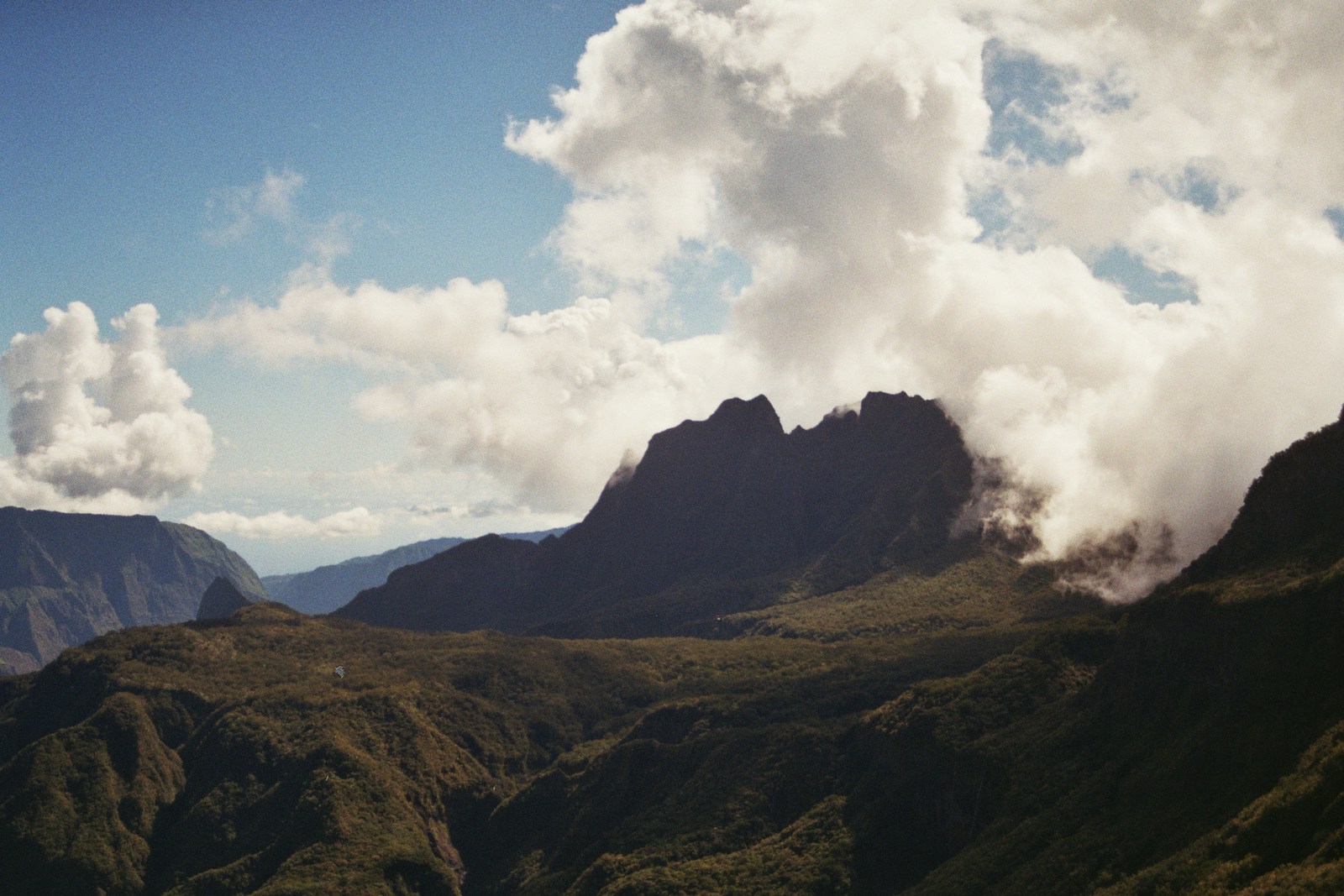
The settlement of Réunion closely follows the geography. The coastlines, more accessible, early concentrated ports, trade and administration. The highlands — slopes, high-altitude plains, cooler areas — developed with agricultural expansion, the need for new land, and sometimes the search for social or economic removal. The cirques (Mafate, Salazie, Cilaos) became worlds apart: enclosed, marked by strong solidarity, an economy long oriented toward self-sufficiency and pedestrian circulation.
Our Vacation Rentals in Réunion
Walking on an island of memories: hiking and reading the landscape.
Marcher sur une île de mémoires : randonnée et lecture du paysage
The trails of Réunion are not merely tourist routes: they often overlap with old thoroughfares, cultivation areas, passages used for local trade, and even paths linked to the history of maroonage. Understanding the island also means learning to read its landscapes: the former plantations, the casas, the ramparts, the rows of villages, and traces of economic transformations.
To prepare an outing under good conditions, the internal resource Preparing your hiking pack for the island can serve as a practical guide. And because Réunion’s environment can be demanding (changeable weather, elevation changes, technical terrain), the page Safety tips for hiking on the island reminds readers of the essential reflexes.
Modernization, departmentalization and social recompositions
The 20the century marks an acceleration of changes. Departmentalization in 1946 transformed the political and administrative framework. Infrastructure developed, schooling became widespread, public health advanced, and the economy reorganized. These advances were accompanied by tensions: economic dependencies, persistent inequalities, rapid changes in lifestyles and questions of identity.
Internal migrations intensified: from rural areas to cities, from the highlands to the coast, with the rise of new neighborhoods and new forms of sociability. At the same time, Réunionese culture asserted itself: languages, music, cuisines and festivals became arenas of claim and recognition, notably to rehabilitate heritages long marginalized.
Living culture and leisure: continuities and new practices
Contemporary Réunion does not set tradition against modernity: it makes them coexist. Outdoor and sports practices, for example, fit into a continuity of an older relationship with the relief, while responding to new desires for adventure and discovery. The sea and the mountains, close to each other, allow a rare diversity of activities in a compact area.
To explore this more contemporary facet, the internal resource Canyoning paragliding and sporting adventures on the island shows how the island is also experienced through experience, movement, and attention to the natural environment.
A relational identity: belonging to the island, belonging to others
What is striking in the history of Réunion's settlement is the way a society invented itself without an initial indigenous foundation, transforming a succession of uprootings and constraints into a common world. This does not erase the violences of colonial history, nor the inherited hierarchies, nor the wounds of slavery and indentured labor. But it highlights the strength of cultural creation: a shared language, arts, music, cuisines, rituals and ways of being together.
Réunion is thus an island of relationships: to the Indian Ocean, to France, to regional neighbors, and to its own internal diversity. Its population is not a mere demographic fact: it is the engine of a culture that continues to reinvent itself, holding memory and the present together.
Staying to better understand: living the places, the rhythms, the encounters
Discovering the island through its history and culture requires time: the time of markets, museums and neighborhoods, but also the time of conversations and shared meals. To organize a stay and branch out to different regions (coast, highlands, cirques), you can consult the internal page Our Seasonal Rentals in.
 Français
 Español
 Deutsch
 English