
history of sugarcane Réunion
history of sugarcane Réunion — On the island of Réunion, sugarcane is not limited to a landscape of fields swaying in the wind: it is a historical backbone. It shaped land use, organized labor, structured ports and roads, fed fortunes as well as tragedies, and stamped its rhythm on the seasons. From a crop introduced into a still-young territory to a sector now mechanized, regulated and export-oriented, sugarcane accompanied — sometimes imposed — the island’s social and economic transformations. Tracing this trajectory is to tell an essential part of Réunion, at the crossroads of the Indian Ocean, colonial empires and the global sugar markets.
From the colony’s beginnings to the first canes: a gradual establishment
Réunion (then Île Bourbon) was occupied and developed in the second half of the 17the century. The colony’s first decades were mainly characterized by a subsistence economy and attempts at cash crops, depending on experiments, available soils and immediate needs. Sugarcane, already grown in other tropical regions, gradually integrated into this environment: it requires water, space, labor, and a technical organization (crushing, boiling, crystallization) that cannot be improvised.

At first, farms remained modest. Sugar production requires installations — mills, boilers, buildings — and expertise that the colonists acquired little by little, sometimes thanks to the movement of people and techniques between islands. The first canes did not yet herald the absolute dominance of this crop, but they foreshadowed a model: an exportable, monetizable product dependent on infrastructure and intensive labor.
To better place this rise in a broader context, one can consult a concise overview available on the history and culture of sugarcane in Réunion, which puts into perspective the plant’s gradual rooting in island life.
The 18the century: cane becomes an economy, the coastline is transformed
In the 18e th century, the colony organizes itself, concessions expand and the cultivation of the coast intensifies. Cane benefits from lower, more accessible areas better connected to embarkation points. The logic is simple: produce close to processing sites, then transport to the ports. As production grows, land use is rationalized: land is cleared, irrigated, paths laid out, and plots distributed according to a hierarchy of agricultural values.
Cane is not alone: coffee, clove, cotton and other crops factor into economic choices. But sugar has a major advantage: European demand, supported by international trade dynamics. Yet this demand is not enough by itself: production must be kept stable, climatic hazards absorbed, and above all there must be labor for fieldwork and for the factory (which, at the time, is often still integrated with the estate).
This is where cane, as elsewhere in the colonial domain, ties into a system of forced labor. Sugar structuring accompanies the rise of slavery on the island: an economic and social arrangement that leaves a lasting mark on Réunionese memory. The fields, mills and boilers are not only technical elements: they testify to a brutal organization of labor, a control of bodies and a hierarchical social order.
Our Vacation Rentals in Réunion
19e th century: sugar golden age, central factories and social shifts
From the estate workshop to the factory: industrial centralization
The 19e th century is often associated with the decisive rise of cane in Réunion. Several factors converge: technical advances (better mills, steam, improved extraction), the rise of larger processing units, and the pursuit of economies of scale. Where production had previously taken place on the estate with limited means, the trend is toward centralization: the factory becomes a hub, and planters organize themselves around its capacity to crush and crystallize.
This transformation does not concern only technology. It also reshapes space: transport axes adapt, infrastructures develop, and the organization of working time synchronizes with the sugarcane season (the cutting and crushing period). Sugarcane imposes a collective calendar, especially in areas where it dominates almost all available land.
Abolition of slavery, indentured labor and workforce reconfiguration
The abolition of slavery in 1848 profoundly disrupted Réunionese society. The sugar economy, dependent on a large workforce, had to reorganize. As in other colonies, the use of indentured labor (contract workers, notably from India) became a major lever to maintain production. These governed and unequal migrations added a complex layer to the island’s social history: new communities, new tensions, new forms of dependence.
In this context, sugarcane was both a driver of economic integration and a revealer of inequalities. It fed export and credit circuits, favored owning groups, while leaving a large portion of workers in lasting precariousness. The memory of this period is not only that of the industry: it is also that of living conditions, housing, disease, resistance, solidarity, and cultural transmission.
A resource for understanding: archives, geography and scholarly analyses
For those wishing to deepen the territorial and historical dimension of sugarcane at the island level, an older but enlightening academic document remains available online: a study on sugarcane in Réunion, useful for understanding how geography, economy and production structures articulate over time.

Sugarcane and rum: a parallel, sometimes intertwined history
In Réunion, sugar is not the only story told by the cane. Molasses and certain juices can be valorized in alcohol production, and rum has long been part of the economies of cane-producing islands. Links between sectors vary according to periods, policies and markets, but the collective imagination often retains this association: cane, distillation, know-how, and popular sociability.
Rum production is not just a tradition: it depends on industrial choices, regulations, quality standards, markets, and trade-offs between sugar and alcohol. At certain times, distillation can represent diversification; at others, it accompanies crisis cycles or restructurings. For a terroir- and discovery-oriented presentation, the page Sugarcane and rum offers a clear overview of the links between the plant and this emblematic production.
Crises, competition and transformations in the 20the century: surviving, modernizing, reorganizing
The 20the century is not a straight line to prosperity. Sugar is an unstable global market: price fluctuations, competition from other producing regions, the rise of beet sugar in Europe, wars, changes in trade policies. For an island far from major consumption centers, the question of costs — transport, mechanization, yields — is decisive.
The Réunion industry goes through phases of concentration: fewer factories, larger; higher technical demands; a more contractual relationship between growers and industrials. Modernization affects cutting, loading, transportation of cane, and processing. Landscapes change too: some areas remain under cane, others shift to urbanization or other uses, notably on the coast where land pressure intensifies.
At the same time, cane remains a social marker: it provides livelihoods for thousands of people, directly or indirectly. The countryside continues to shape activity, and questions of pay, quotas, public support and value sharing remain central. Cane is thus both an industry and a social fact.
The industry today: between identity, economy and environmental issues
Our Vacation Rentals in Réunion
In the 21ste For a century, sugarcane in Réunion fits into a delicate balance. On one hand, it remains a major crop, a pillar of agriculture, and a strong element of identity: it still shapes landscapes, habits, tastes, and part of local celebrations or narratives. On the other hand, it faces structural challenges: adapting to climate change, water management, energy costs, modernization of practices, competition, and reforms of trade frameworks.
Environmental issues are increasingly visible: soil erosion on certain slopes, management of inputs, preservation of biodiversity, and valorization of residues (bagasse, scums, vinasses depending on processes). The current logic often favors multi-valorization: deriving several products and services from the same plant (sugar, energy, by-products) in order to improve economic resilience.
But beyond the numbers, sugarcane continues to be experienced daily. People chew it by the roadside, find it in processed products, see it burned (a practice increasingly regulated), and follow it from field to factory. It remains a concrete link between land, labor, and memory.
An insular history connected to the world: understanding sugarcane over the long term
The history of sugarcane in Réunion is inseparable from a global history of sugar: botanical movements, transformation techniques, transoceanic trade, and colonial constructions. Local trajectories are never isolated: they depend on distant political decisions, market norms, innovations from elsewhere, and international crises.
To place Réunion sugarcane in this long global duration (from its Asian origins to its spread in the tropical worlds, up to plantation systems), a useful read is offered by this short history of sugarcane, which helps to understand how the plant became a major economic object.
Sugarcane in Réunion culture: landscapes, gestures, and the table
Sugarcane is visible, but it is also intimate: it shapes the way people talk about work, describe the seasons, evoke the coastal heats, or recount childhood memories. It is associated with gestures: cutting, tying, loading, crushing. Even for those who no longer work in the sector, it remains a familiar backdrop and a territorial landmark. Some neighborhoods were built around the mills; some roads still seem to follow transport logics inherited from that past.
On the culinary side, cane is not just powdered sugar. It permeates taste habits, desserts, syrups, candies, and also accompanies dishes by contrast (sweet-and-salty, caramelizations, sauces). To link this dimension to Réunionese dining in a broader sense, you can read a guide to better understand the basics of Creole cuisine, which helps grasp how products and inheritances combine on the plate.
And if you want to extend the experience with a typical meal, this selection of places and tips around cari helps find where to taste classics, often served with side dishes whose balance of flavors recalls the historical importance of sweet products in culinary habits.
Tracing this history: routes, viewpoints and other plantation cultures
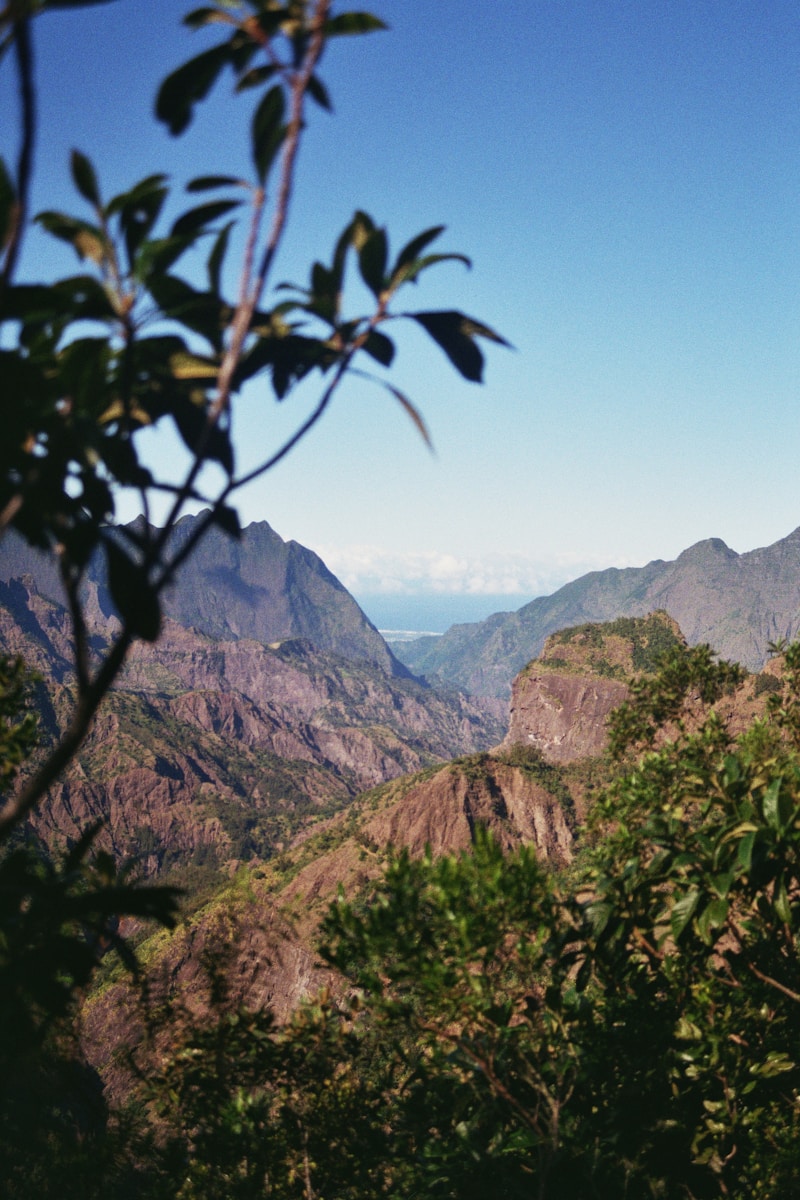
Understanding sugarcane on Réunion also involves observation: reading the relief, spotting cultivation areas, comparing the coast and the highlands, understanding why certain plots are where they are and not elsewhere. Viewpoints are particularly telling, as they reveal the geometry of the fields and the continuities between agricultural plains and urbanized areas. To organize a simple exploration, these viewpoints accessible by car are a good way to see how cane fits into the landscape.
Sugarcane is not the only plantation crop that has marked the island. Coffee and vanilla tell of other cycles, other know-how and other territories, sometimes complementary, sometimes competing depending on the periods. If you wish to compare these agricultural heritages, this route around coffee or vanilla plantations allows you to broaden your perspective and better understand the diversity of Réunion's agricultures.
Finally, for a discovery closer to the fields, cycling offers a slow, tangible reading of agricultural areas, between vegetal scents, changes in relief and crossings of towns linked to the sugar economy. These cycling routes can help choose roads where cane, depending on the areas, remains omnipresent.
Our Vacation Rentals in Réunion
Conclusion: a plant-memory at the heart of an island in motion
Sugarcane on Réunion is much more than a profitable crop: it has been a matrix. It contributed to the birth of a colonial order, the rise of an industry, the arrival of new populations, and the construction of landscapes recognizable above all others. It also carried violences and inequalities that are an integral part of the island's history.
Today, the sector continues to transform, between economic demands, environmental constraints and societal expectations. But cane remains a common thread: in the fields, the factories, the products, and the collective memory. Traveling to Réunion with this thread in mind is to read the island differently: not as a mere postcard, but as a territory where land, labor and history respond to one another.
If you wish to stay close to these landscapes and organize your visits, you can consult our holiday accommodations on the island.
 Français
  Español
  Deutsch
  English